




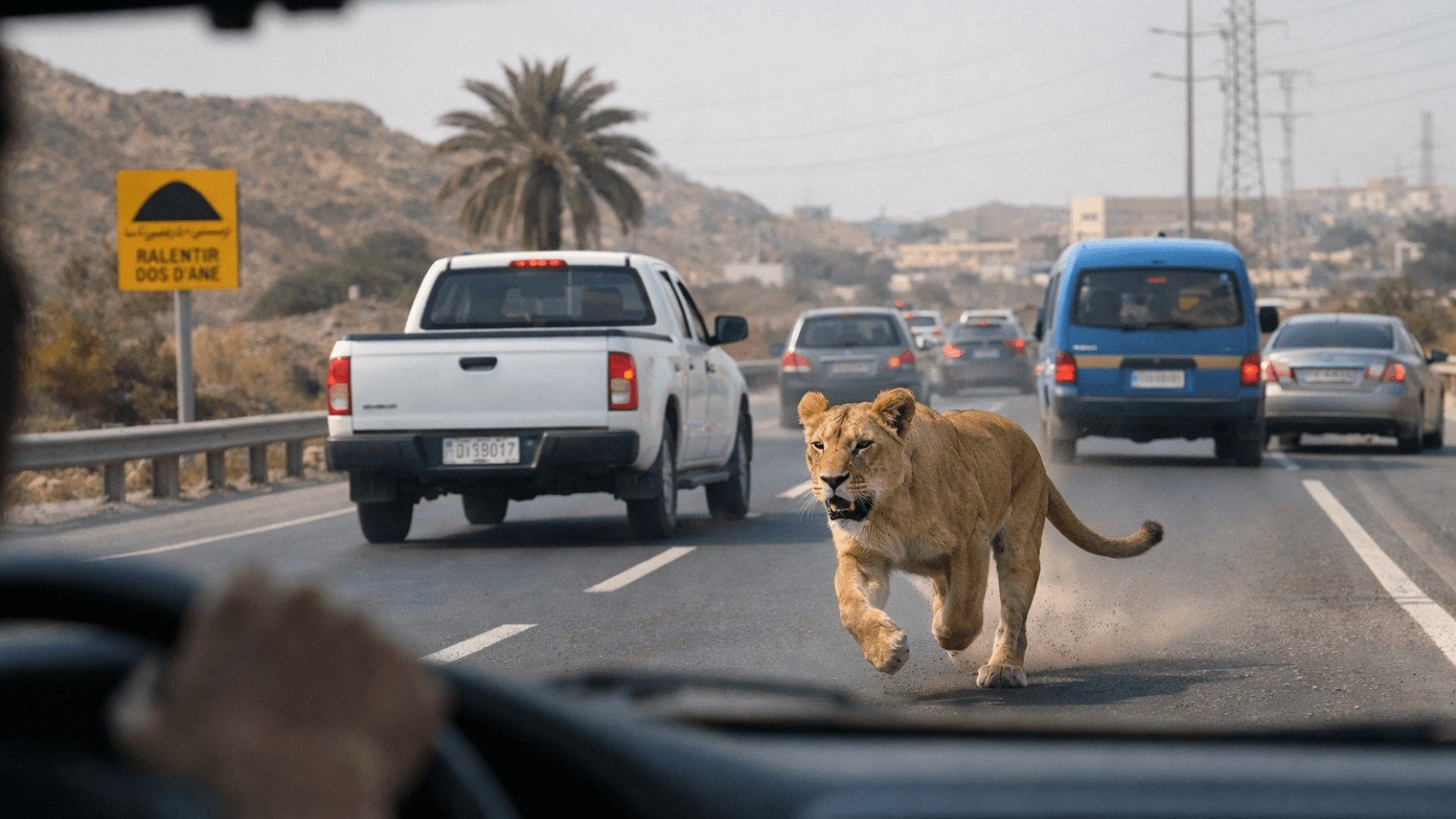
The AI lion video Djibouti story exploded across social media earlier this week after a hyper-realistic clip appeared to show a lioness sprinting down a busy highway, terrifying drivers and bystanders alike. Within hours, the footage was everywhere—WhatsApp groups, TikTok feeds, X timelines—fuelling fear, confusion, and frantic speculation.
For a brief moment, many viewers believed a dangerous wildlife escape was unfolding in real time.
It wasn’t.
AI Lion Video Djibouti: How the Clip Took Over the Internet
The video first surfaced through private messaging apps before spilling onto public platforms. Shot from what appeared to be inside a moving vehicle, the footage showed a lioness charging along a paved road, dust kicking up behind her as cars slowed to avoid the animal.
The realism was unsettling.
The lighting looked natural.
The motion felt authentic.
The animal’s gait appeared convincing.
That combination proved explosive.
Within hours, captions claimed the lion had “escaped,” “appeared mysteriously,” or was “roaming freely.” Panic spread faster than facts, prompting worried residents to demand answers.
Officials Forced to Intervene as Fear Grows
As the clip continued to circulate, local authorities were forced to step in. Officials issued a public warning urging residents to remain calm and stop sharing unverified footage.
According to official statements, no lions were loose, and there was no real-world incident behind the video. The clip, authorities said, appeared to be AI-generated.
The announcement helped slow the panic—but it raised a far bigger concern.
If this video fooled millions, what else could?
Why the AI Video Looked So Real
Experts say the effectiveness of the AI lion video Djibouti incident highlights how far generative technology has advanced.
Modern AI tools can now simulate:
- Natural animal movement
- Realistic camera shake
- Accurate lighting and shadows
- Environmental depth and dust effects
These details, once reliable indicators of authenticity, are no longer dependable.
Many users admitted they initially believed the footage was real, calling it “terrifying,” “too convincing,” and “impossible to fake.” That reaction is precisely what makes these videos so dangerous.
The Rise of “Hallucinated” Wildlife Sightings
The Djibouti lion clip has reignited global discussion around so-called hallucinated wildlife sightings—AI-generated videos showing animals in places they do not belong.
Similar fake clips have already surfaced worldwide, depicting:
- Sharks swimming in flooded streets
- Bears wandering through city centers
- Exotic animals appearing in suburban neighborhoods
Each incident follows the same pattern: shock, fear, virality, and eventual debunking—often too late.
Why This Hoax Hit Harder Than Others
Unlike obvious deepfakes or stylized AI content, this video leaned heavily into realism. There were no dramatic angles, no exaggerated effects, and no obvious visual glitches.
It looked like something a regular driver might film on a phone.
That’s what made it believable.
And that’s why it triggered such a strong reaction.
A Warning Sign for the Future of Viral Media
The AI lion video Djibouti incident may ultimately be remembered as a turning point—a moment when the public realized just how fragile visual trust has become.
Government warnings are rare in response to viral videos. The fact that officials felt compelled to intervene underscores the seriousness of the situation.
As AI tools become more accessible, similar incidents are likely to become more common, not less.
Conclusion
The viral AI lion video Djibouti panic wasn’t just about a fake animal—it was about the collapse of certainty in the digital age. When realistic visuals can be generated in minutes and shared globally in seconds, the line between real and fabricated becomes dangerously thin.
This incident serves as a stark reminder: viral doesn’t mean verified, and realism no longer guarantees truth.
As technology evolves, skepticism may become the only reliable defense.